Thursday, August 30, 2007

Derek Webb at UConn


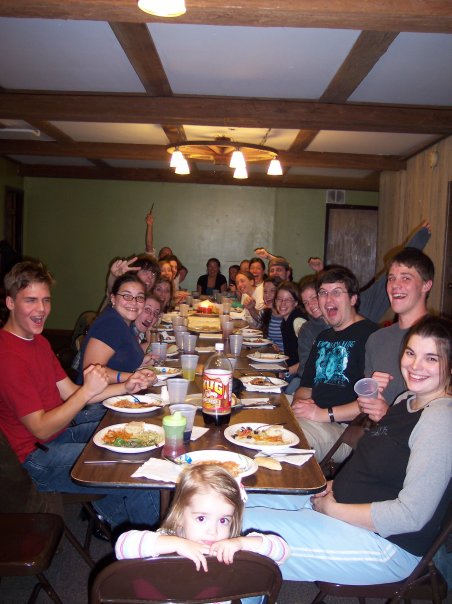
We are thrilled at the opportunity to bring Derek Webb (with opening act Kelley McRae) to UConn this coming Tuesday! This show is the first in a series of Northeast dates for Derek, and the only show in CT, so if you're in the area come on out! Tickets are only $5 and because of a generous grant from the Day Foundation (started by the founder of Days Inn), 100% of the proceeds from the show will go directly to the Hartford Rescue mission. We have developed a great relationship with Gregg Woods, director of the mission, as we bring a group of students to volunteer once a month. The rescue mission serves meals six nights a week in their North Hartford neighborhood (in the poorest zip code in CT). So that's just one more reason to come.
See you Tuesday night!

For more about Derek and Kelley, visit their websites:
DerekWebb.com
KelleyMcRae.com

Saturday, August 11, 2007

People Get Ready


I'm looking forward to UConn starting back in a couple weeks. Please pray for me as I prepare for the juggernaut that is the Fall semester. Thankfully because I've been doing supply preaching at a local church that doesn't have a pastor, I have the first four messages I'll give at UConn in pocket. Hopefully that will relieve me to spend more time with students as well as my family during this hectic time. I will be going back to the gospel of John (I did John last Fall), starting where I left off in chapter six. This was completely unintentional, but it just so happens that John 6 contains the first of Jesus' seven "I Am" proclamations in this gospel. The theme this semester as I see it taking shape in my studies is "life"--what is it all about and how do we go about living it? Every time I sit down to write a sermon, I'm thankful I don't have to start at square one. There's plenty that's been said by a lot of people who are smarter than me about the Bible. No matter where I am in the Bible, I always find myself coming back to Calvin's Institutes: "Nearly all the wisdom we possess, that is to say, true and sound wisdom, consists of two parts: the knowledge of God and the knowledge of ourselves." And as Calvin said in another place in the Institutes, "In knowing God, we know ourselves." Please pray with me that students at UConn would come to know themselves, maybe even for the first time, as they come to know their God this semester.

Saturday, July 21, 2007

Summertime in CT


Really enjoying the debut from St. Vincent (aka Annie Clark). Very weird, but very genius. Apparently live she produces all of the sounds on this record by herself. It's her, a guitar, a sampler and a kick drum. Hope I get to see that for myself.

And the new Ryan Adams (Easy Tiger) does not disappoint either. It's like he finally just got over himself and made the Neil Young-inspired record we all wanted him to make.

It's nice to have time to make my way through the stack of books I've collected over the past six months. A couple highlights:

Body Piercing Saved My Life: Inside the Phenomenon of Christian Rock

by Andrew Beaujon
is more a journey inside the phenomenon of American Christian subculture. Written by a guy from Spin, it is surprisingly balanced and insightful. Especially amusing are his reactions to insider language evangelicals take for granted, like why churches are "planted" and not just, um, "started."

Terrorist by John Updike
is the first Updike novel I've ever read. I filled his prescriptions when I worked part-time as a pharmacy tech in a posh Boston North Shore town during my seminary days. Always wanted to ask him about his poem, Seven Stanzas at Easter, but could never summon the courage. Came across a quote by him in Eugene Peterson's Eat This Book. Updike said Karl Barth's book The Word of God and the Word of Man gave him "a philosophy to live and labor by, and in that way changed my life." He sums up the Biblical world view as he drew it from Barth: "that truth is holy, and truth-telling a noble and useful profession; that the reality around us is created and worth celebrating; that men and women are radically imperfect and radically valuable." Yeah, I think it's safe to say we should read Barth again.

Tuesday, May 22, 2007

RUF Summer Conference


Just got back. We logged just under 60 hours in the car (there and back). We had a great time but it's good to be home. Mike Campbell was the speaker for the week. He's an African American PCA pastor in Jackson, MS. His passion is racial reconciliation and that came through in his messages on "Dying to Sin, Living to Christ." One night we went bowling (that explains the matching tube socks and the blacklight friendly airbrush tshirts). Thanks to those who gave scholarships so students could go.

Thursday, March 22, 2007

The angel and the cup


After Jesus' terrible prayer at Gethsemane, an angel came to him and gave him strength, but did not remove the cup. --Wendell Berry, Jayber Crow

Some writers seem to have an inborn ability to capture a certain mood and sustain it until you become mesmerized. Berry is one of those. There is a certain silence that you can cut with a knife--a silence you can feel. And you feel it most when you are alone. That feeling is what Berry captures so well. It is a "Be-Still-and-Know-That-I-Am-God" kind of solitude, the kind that causes the pang behind the pang to well up inside you.

It's been three months since we held our precious Caroline. The pangs of sorrow are still very deep and for some reason they have risen to the surface this past week. Today I had to go approve the etching for her gravestone. I had no idea how difficult it would be. When I walked in the door, it felt like someone punched me in the stomach. There, laid across a drafting table on thin white carbon paper was my dear daughter's name with the date underneath: December 16th, 2006. Underneath will be a picture of a small lamb with the inscription, "I Am Jesus' Little Lamb -Isaiah 40:11." That verse says, "He will tend his flock like a shepherd; he will gather the lambs in his arms; and gently lead those that are with young."

Sometimes it feels like he didn't really drink the cup all the way down. That some has spilled out on us.


Saturday, March 03, 2007

King of Queens


This weekend we're hanging out with our good friends the Hickmans in Queens. Pat and Stephanie Hickman started an RUF ministry at St. John's here about the same time we started at UConn. It has been so good to connect with friends who are doing exactly what we are doing (in a very different setting). When they visit us it's for a break from the stress of city life and when we visit them it's for a break from feeling like we're in the middle of nowhere :). Today we took the kids to a really cool place, the CMA (Children's Museum of Art), where Nadine, Patton, Hogan and Libby got to paint and make clay sculptures. Then we walked about 15 blocks through Soho to Washington Square and ate at the Peanut Butter Co. Pat and I got the "Elvis" sandwich--peanut butter, banana and honey of course--but with a unique bonus that I'm sure Elvis would have loved: bacon. I think it goes without saying that it was good.

Thursday, February 15, 2007

Frozen Ocean


Last weekend UConn RUF joined RUF groups from Trinity College, Yale and the University of New Haven for our second annual winter conference in Cape Cod. As cold as it was, we had an amazing time. I saw something I've never seen before--a frozen ocean--and it was nothing short of spectacular. It looked like Antarctica. Interesting fact: When the ocean freezes, it freezes in waves (it's not flat). Incredible. My friend Abe Cho from citylife church in Boston was our speaker for the weekend, and he did a great job talking about how the gospel is meant to "dig up our roots" and transform us. The Spirit was at work in the Word--there were many tears shed as students (and campus ministers) began to look honestly at the bad roots that so easily become entrenched in our hearts, turning even "good" works into weapons against God. One of the more insightful things Abe pointed out is that when you look at your heart (instead of your good or bad behavior), you are seeing the motivation behind why you are doing what you are doing. For example, take something most of us would say was good fruit in our lives, evidence that God is at work in our hearts--honesty. Now think about how often for you telling the truth is motivated by either guilt or fear. Guilt: "I'm going to tell the truth because I don't lie, I'm not a liar, I'm just not that kind of person." Fear: "I'm going to tell the truth because I'm scared of the consequences if I don't," OR "I want this person to think better of me than they already do--I'm not lying, I'm just witholding information." Notice the root motivation behind the outwardly "good" behavior is bad. There is no gospel root at all. So what does good fruit look like then? It is honesty rooted in the freedom the gospel brings. And what does the gospel have to say about freedom? We are set free from our bondage to other people's approval. We are set free from our bondage to our sin. So we tell the truth not because we are good people, not because we are afraid, but because we love the God who set us free and who calls us to tell the truth even as He tells us the truth about our hearts. All of this is from the book How People Change by Lane and Tripp (www.ccef.org), which I would highly recommend to you.

Monday, February 05, 2007

Arcade Fire in NYC


My friend C.J. (now the #1 coolest friend I have) emailed me last week to tell me he got us tickets to go see one of our favorite bands, the Arcade Fire, in NYC next weekend. Just how hot are these tickets? The band is playing five straight nights and all five nights sold out online in five minutes. Gothamist has a post about the show.

What is so great about this band? Well, one of the fruits of reading Seeing Through Cynicism is this quote:
In popular culture, modern knowledge has become "postmodern knowingness." Earnestness and seriousness are out. Frank Gannon wrote: "Something in the human mind says it's hopeless: The existence of God is something that human beings can never entirely discount, or entirely prove. Why torture yourself trying to answer a question like that? Get a hobby. Work out regularly. Eat low fat. Forget about what Yeats called "vague immensities"...Yet something deep in your soul says, Go ahead. Seek the ultimate answers. Maybe the human brain can actually "know" some transcendent divinity. Yeah. Good one. Don't hurt yourself, OK?
Keyes elsewhere quotes Robert Wright's The Moral Animal:

What is to be avoided at all costs in the postmodern age is earnestness, which betrays an embarrassing naivete...

University of Memphis head coach John Calipari sums it up well: "It's not cool to care." By postmodern standards, then, The Arcade Fire pulls up their pants to their armpits and LOVES linux. There is no irony. There is no winking "knowingness."

They sing songs about missing their parents.

Wednesday, January 24, 2007

Seeing Through Cynicism


Simply put: the book of the year, bar none. The most substantive, meaty, challenging, thought-provoking book I've read in a long time. Dick Keyes (I recently learned it is pronounced "KAIS," not "KEYS") is the director of L'Abri Fellowship in Southborough, MA. Do yourself a favor and buy it at wtsbooks.com (their 1 day delivery never ceases to amaze me). A longer post on the book is coming soon.

Wednesday, January 17, 2007

Back at UConn/Update


The Spring Semester has officially begun. We had a great first meeting and it was so good to see everyone. Thanks again to all of you who have come alongside us and supported us during this time. Katie and I are still hurting (we have good days and bad ones), it mostly feels strange to go back to "normal life." Our faith in God's "meta-story" has been both strengthened and challenged by this great loss. We are clinging to the Romans 8:28 truth that God is at work bending even this tragedy for the good of His people. Sinclair Ferguson recently preached on that text and gave one of the best sermons I've heard on trusting in the providence of God (It's entitled "All Things for Good?"). I would highly recommend listening to it on his podcast. Search for "First Presbyterian Columbia" in iTunes.

Tuesday, December 19, 2006

Caroline Laura

For those of you who haven't heard, we've had a tragedy in our family. We went in to Hartford Hospital on Saturday to check on our baby (due Dec. 26th) and the doctors found no heartbeat. Our little daughter, Caroline Laura, has gone to be with the Lord. Katie underwent a C-section surgery to remove her, and they found that her umbilical cord was wrapped around her neck.


Please pray for us during this very difficult time. Thanks to all those who have visited, called or emailed and come alongside us. We are at home now and Katie is resting and recovering with her parents here. Nadine is young enough that she doesn't understand what has happened, and we see that as God's grace to us. We are entrusting Caroline to God's hands--they are good hands.


We will have a small graveside service for Caroline tomorrow at 11am at the historic Center Cemetary in Coventry, CT.

Thursday, December 14, 2006

Dustin Salter updates


For those interested in updates on Dustin Salter (RUF Campus Minister at Furman University in SC), visit this site, which is updated often. Please continue to pray for Dustin and his wife Leigh Anne as well as for his three young children, Jacob (9), Nathan (7) and Meredith (2). Also pray for the students in RUF at Furman.

Tuesday, December 12, 2006

Exculpating Jean Cauvin


Marilynne Robinson won the Pulitzer Prize this year for her novel Gilead. Her prose is beautiful, measured, and full of great theology. The novel is centered around a 70 year old preacher who is writing a memoir for the benefit of his young son. He reflects on his life--mistakes he has made, and what time has taught him about the glory and ruin of the human condition. John Calvin shows up a lot, which made me wonder about Robinson's own theology.


So I was excited to hear recently that pre-Gilead, post-Housekeeping she had written a series of essays on, who else, John Calvin (she refers to him by the French Jean Cauvin), in which she defends him against the bashing of modern critics like Max Weber (The Protestant Ethic and the Spirit of Capitalism) and Perry Miller (The New England Mind), both famous for originating the now widely accepted belief that Calvinism and Puritanism were (and are) bleak, joy-killing, repressive movements. For her full take, read the book, but here's a sampling of her thoughts, here on the false association of the Calvinist doctrine of election with "elitism":


While Calvinists spoke of an elect, Leninists and suchlike have spoken of an elite. The two words come from the same root and mean the same thing. Their elect [Calvinists'] were unknowable, chosen by God in a manner assumed to be consistent with his tendency to scorn the hierarchies and overturn the judgments of this world. Our elites [American society] are simply, one way or another, advantaged. Those of us who have shared advantage know how little it assures, or that it assures nothing, or that it is a positive threat to one's moral soundness, attended as it is with so many encouragements to complacency and insensitivity...The American salvation myth and the Stalinist salvation myth have in common the idea that the great body of the culture is a vast repository of destructive notions and impulses, that certain people rise out of the mass in the process of understanding and rejecting all that is retrograde, and that, for those people, there is never any use for, nor even any possibility of, conversation on equal terms with those who remain behind. The history of elites is brutal and terrible.


Note: One theological side note worth mentioning: While it is true that in one sense we cannot "know" who is elect and who is not (since we don't have the Lamb's book of life open in front of us), Scripture is clear about who the elect are: they are those who sense their unworthiness before God and call upon the name of Christ. That is the only ground of assurance for Christians. In this sense, the biblical doctrine of election is quite the opposite to elitism--it should properly produce humility rather than pride.


Relating this to how we treat our unbelieving friends (or our believing friends who we think don't "get it"), think about the cruel and harsh words and tones we often use in speaking about individuals or groups of people who, in Robinson's words, "remain behind." If the world is ever going to be convinced that God's elect are not "elite," we must take heed of not only what we are saying but how we are saying it. More importantly, we must examine our hearts for elitist attitudes and begin to repent of them.

Monday, November 27, 2006

Wedding on top of Lookout Mountain, GA


Last month I had the honor of preaching at my cousin Lisa's wedding, and this is the transcript of my message. Note: As someone who often has to endure grief for my name (in New England, "Joey" is either a little kid or a baby kangaroo, not a pastor's name to say the least), it warms my heart to know that I now have someone (in my family no less) who must endure more. :)
The above picture is a lithograph of Lookout Mountain circa 1866.

October 28, 2006

Lisa and Trippy,

It is a great honor and a privilege to be able to give you a charge from Scripture to begin your marriage. For those of you who don’t know, Lisa is my first cousin, so this is a special honor for me to participate in this service.

Marriage is a picture or a drama that was meant to point us all to Christ. It is God’s idea, he created it, and he uses it again and again in Scripture as a metaphor to show how he loves us, that He has committed himself to love his people even as a groom commits himself to care for his bride, even tripping over himself in his eagerness to show us his love. Last night at the rehearsal dinner we heard all kinds of stories from family and friends about how God has already been at work knitting the two of you together, as different as you are, and we’re here tonight to witness God now binding you together to become one flesh.

Of course one of the tragic effects of the Fall is that marriage is often seen as a means to an end of personal fulfillment, and what God intended to be a drama of love and redemption becomes in reality a story of two warring kingdoms, each trying to gain power over the other. The question I want to consider for a few moments is this: What will bind the two of you together to make your marriage a gospel drama rather than a self-centered power struggle? What will make your marriage last? My charge to you from Ephesians 5 that you’ve already heard read is this: Let nothing come between you; but in order to do that you must let Christ come between you to be your example and to be your forgiveness.

In the drama of marriage, there are two roles to be played. Trippy, your role, your calling is to be the head of the household in the same way Christ is the head of the church. This idea of “headship” is often misunderstood. It is not as though men are superior to women, and so women should submit. Also there is no sense of domination or cruelty in it. No, the biblical idea of headship, Trippy, mirrors Christ, and is a loving and sacrificial responsibility to care for Lisa, to consider her needs before your own, to lay down your life for her, not only when she is in danger, but also in the more mundane moments of your daily lives. Like when you know you’re right; in fact, you know your point is so ironclad and logically airtight that it cannot be disproven, and yet you are willing to lay all of that aside and listen to her, not because it’s the noble thing to do, but because you are completely and utterly convinced that that is what Jesus has done for you. In fact, you will never be able to truly love Lisa sacrificially until you are convinced that you have been loved by God in that way. When his accusers brought him to the cross, Jesus knew, and he was the only person who ever lived who could say this, that every charge of wrongdoing that was brought against him was false—that he was completely in the right. And yet, because he loved us and considered our eternal security and happiness as more important than his own vindication, he laid down his life for us. So Trippy, your role, your calling as Lisa’s husband is that for the rest of your life, until death separates you, you are to serve her, to honor her, when there’s a choice between making you or her look better, you choose her. You are to listen to her, to be quick to repent when you fail, and to be quick to forgive when she fails.

Paul goes on and describes the wife’s role in this drama of redemption that marriage is mirroring. Lisa, Scripture says you are to submit to Trippy in the same way the church submits to Christ, and to respect him. What does that look like? Again, this passage can be misused and often it is exploited. Paul is not saying women are somehow inferior to men. If you look at how Jesus treated women and the teaching of the rest of the New Testament, you’ll find the Bible is radically opposed to that idea. No, submitting to your husband means that as you see him serving you and honoring you, you respond in kind. Now wives, before you elbow your husbands and say, “See, if you would just lay down your life for me everyday, this whole submitting thing wouldn’t be so hard,” one way the church submits to Christ is by forgiving the same way Christ forgives. And how has he forgiven us? Do you understand that Jesus, in dying on the cross and rising from the grave has not only removed every ounce of punishment our sins deserve, but has also said to us, “I remember your sins no more!” He is quite seriously saying to all who put their faith in him, “I have forgotten how you have wronged me.” How does that relate to your marriage?

Lisa and Trippy, you are each marrying a sinner! And there will be times in your marriage when it will be tempting to bring up past wrongs--there’s no more effective weapon than that when you have been hurt—but it will destroy your marriage if you let it. Forgiveness is hard, because it means forgetting how you’ve been wronged. Not forgetting that it happened (that takes longer), but it means you no longer bring it up. It is hard to do that, it costs you something, it means you can no longer use it to justify your anger. And listen, you’re not going to be able to do that by pulling a Dr. Phil—you know, “Just dooo it!” No, you have to look to Christ! The only person or thing that should come between you is Christ. Because He is the only one who can bind you together in love, to not only be your example for how to love each other, but also your forgiveness and righteousness when you fail to love each other well, and you will. It make sense that forgiveness is costly and hard, because it was costly for God! He couldn’t simply snap his fingers and forgive us, because he is just and justice would not be done. No, he had to give up the apple of his eye, his only Son, to take the punishment our sins deserved. Our forgiveness comes at a great cost to God!

Lisa and Trippy, I charge you to make Christ the foundation on which you build your marriage. Let him come between you so nothing else will. Don’t look to each other for the deep joy that you were made for, because you won’t find it there and you’ll grow bitter and resent each other for not being able to provide it. Jesus is the joy-giver of life; let him be the joy-giver of your marriage. And when people come into your home and look at your marriage, imperfect as it will always be this side of heaven, they will see a glimmer of the drama of redemption in it. I love you both and may God bless your marriage.

Monday, November 13, 2006

Dustin Salter and RUF Furman

Please be in prayer for Dustin Salter, RUF Campus Minister at Furman University in Greenville, South Carolina. Early this past week he was riding his new mountain bike one street over from his house when he fell and hit his head. He has been in a coma ever since and is showing no signs of improvement. The doctors at this point are hopeful he will survive, but he has most likely suffered extensive brain damage. Dustin is married and has three children. Please pray that God would bring Dustin out of the coma and pray for his wife and children during this very difficult time. Also pray for the over 100 students involved with RUF at Furman, that God would bring comfort and the peace of the gospel. I will post an update on Dustin's condition when it becomes available.

The Sunday before the accident, Dustin preached on the providence of God in Traveler's Rest, SC. You can listen to his sermon here.

Monday, November 06, 2006

G.K. Chesterton on Loving your Neighbor(hood)


My good friend Andy Black has a great blog called The Gash that you should check out regularly (the name is from a Flaming Lips song). He recently put up this short passage from G.K. Chesterton's seminal book Orthodoxy that is worth reading. A little context: "Pimlico" was a down and out London neighborhood in Chesterton's day (completely renewed today). Andy's challenge is this: "Substitute 'Pimlico' for anywhere - your job, your school, your church, your city, the suburb where you grew up. This is one of the most rousing, convicting calls I've ever read."
("Penny Dreadfuls," besides being a great name for a band, were mid-20th century dime novels, the precursors to today's graphic novels and even comic books).


It has been said that the primary feeling that this world is strange and yet attractive is best expressed in fairy tales. The reader may, if he likes, put down the next stage to that bellicose and even jingo literature which commonly comes next in the history of a boy. We all owe much sound morality to the penny dreadfuls. Whatever the reason, it seemed and still seems to me that our attitude towards life can be better expressed in terms of a kind of military loyalty than in terms of criticism and approval. My acceptance of the universe is not optimism, it is more like patriotism. It is a matter of primary loyalty. The world is not a lodging-house at Brighton, which we are to leave because it is miserable. It is the fortress of our family, with the flag flying on the turret, and the more miserable it is the less we should leave it. The point is not that this world is too sad to love or too glad not to love; the point is that when you do love a thing, its gladness is a reason for loving it, and its sadness a reason for loving it more. All optimistic thoughts about England and all pessimistic thoughts about her are alike reasons for the English patriot. Similarly, optimism and pessimism are alike arguments for the cosmic patriot.

Let us suppose we are confronted with a desperate thing -- say Pimlico. If we think what is really best for Pimlico we shall find the thread of thought leads to the throne or the mystic and the arbitrary. It is not enough for a man to disapprove of Pimlico: in that case he will merely cut his throat or move to Chelsea. Nor, certainly, is it enough for a man to approve of Pimlico: for then it will remain Pimlico, which would be awful. The only way out of it seems to be for somebody to love Pimlico: to love it with a transcendental tie and without any earthly reason. If there arose a man who loved Pimlico, then Pimlico would rise into ivory towers and golden pinnacles; Pimlico would attire herself as a woman does when she is loved. For decoration is not given to hide horrible things: but to decorate things already adorable. A mother does not give her child a blue bow because he is so ugly without it. A lover does not give a girl a necklace to hide her neck. If men loved Pimlico as mothers love children, arbitrarily, because it is theirs, Pimlico in a year or two might be fairer than Florence. Some readers will say that this is a mere fantasy. I answer that this is the actual history of mankind. This, as a fact, is how cities did grow great. Go back to the darkest roots of civilization and you will find them knotted round some sacred stone or encircling some sacred well. People first paid honour to a spot and afterwards gained glory for it. Men did not love Rome because she was great. She was great because they had loved her.

Thursday, November 02, 2006

4-Squared


At the beginning of this semester a few RUF students (Tim Colegrove, Scott Colleran and Samantha Fink) decided to play four square in the middle of campus. Little did they know that by Nov. 1st they'd have two weekly games and 27 people showing up to play on Wed. nights--they're even official now. I'm convinced that they're tapping into the ubiquitous "meta-longing" for what we've lost (in this case our childhood innocence)--who knew 4-square could be redemptive?

The RUF-UConn crew (and Nadine as Princess Nadine)


Tuesday, October 24, 2006

The Benefits of Brokenheartedness


We recently took a group of RUF students down to the Hartford Rescue mission to cook food and serve it to whoever came in off the street. University life can be pretty isolating--rubbing shoulders with the poor isn't something our students (or their campus minister) experience every day. Most Fridays Rev. Greg Woods asks the volunteering group to lead a short devotional, so I spoke on Psalm 51 and the "Benefits of Brokenheartedness." As I was thinking about the Psalm in preparation for my message, I was struck by something that should've been obvious to me: "I'm about to talk to a group of homeless people about how to be brokenhearted. Do I even have a leg to stand on?" Would it be patronizing to offer these people anything more than a hot meal and a smile? Certainly any kind of gospel message would be disregarded--"Easy for you to believe," I imagined them muttering under their breath as they nodded politely. After a few more moments reflecting on the Psalm, I remembered something Rick Downs, my pastor in Cambridge, had said: "You're not ready to do mercy ministry until you recognize that YOU are the one that needs mercy. You are the poor one, the destitute, the one who should cry out, 'Have mercy!'"


Is there a bridge the gospel can travel between the suburban rich and the urban poor? Yes, it is our spiritual poverty. The suburbanite does not condescend to the urbanite! He travels a level road because his poverty is no less severe. We are right in hesitating to speak the gospel if we see ourselves as somehow condescending to our hearers. The breathtaking reality is that King Jesus speaks to us from his knees, a servant ready to wash our feet. What a disarming thought! If nothing else, that should put us flat on our faces before the unbelieving world. "Sinners THEN will turn to Thee." (Psalm 51:13)