Tuesday, October 24, 2006

The Benefits of Brokenheartedness


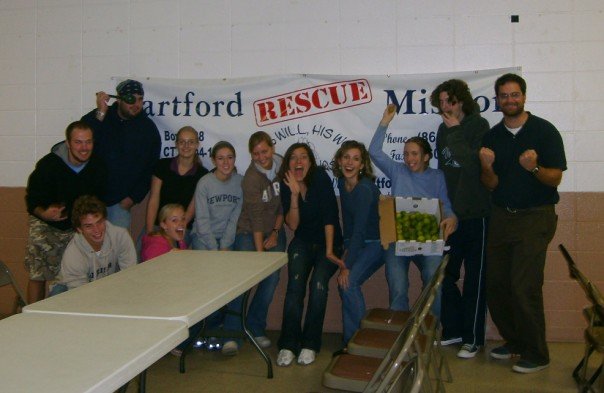
We recently took a group of RUF students down to the Hartford Rescue mission to cook food and serve it to whoever came in off the street. University life can be pretty isolating--rubbing shoulders with the poor isn't something our students (or their campus minister) experience every day. Most Fridays Rev. Greg Woods asks the volunteering group to lead a short devotional, so I spoke on Psalm 51 and the "Benefits of Brokenheartedness." As I was thinking about the Psalm in preparation for my message, I was struck by something that should've been obvious to me: "I'm about to talk to a group of homeless people about how to be brokenhearted. Do I even have a leg to stand on?" Would it be patronizing to offer these people anything more than a hot meal and a smile? Certainly any kind of gospel message would be disregarded--"Easy for you to believe," I imagined them muttering under their breath as they nodded politely. After a few more moments reflecting on the Psalm, I remembered something Rick Downs, my pastor in Cambridge, had said: "You're not ready to do mercy ministry until you recognize that YOU are the one that needs mercy. You are the poor one, the destitute, the one who should cry out, 'Have mercy!'"


Is there a bridge the gospel can travel between the suburban rich and the urban poor? Yes, it is our spiritual poverty. The suburbanite does not condescend to the urbanite! He travels a level road because his poverty is no less severe. We are right in hesitating to speak the gospel if we see ourselves as somehow condescending to our hearers. The breathtaking reality is that King Jesus speaks to us from his knees, a servant ready to wash our feet. What a disarming thought! If nothing else, that should put us flat on our faces before the unbelieving world. "Sinners THEN will turn to Thee." (Psalm 51:13)

Monday, October 16, 2006

Alienation: A Forgotten Road for the Gospel


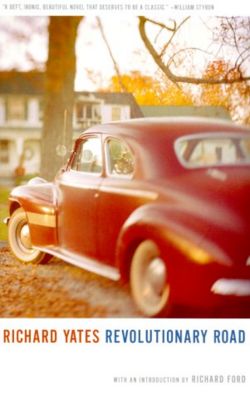
"If my work has a theme, I suspect it is a simple one: that most human beings are inescapably alone, and therein lies their tragedy." (Yates in Boston Review, October, 1999). Should Christians be reading novels with themes this bleak?
It is true that joy (not alienation) should be the central theme of the Christian life. But joy that turns a blind eye to sorrow doesn't suit the reality of life in a broken world. Novels like Revolutionary Road are worth reading because they remind us of our true condition apart from Christ. Sin alienates us from God, and that's why even though we know that Christ has brought us near, we often get the feeling we are "inescapably alone." I need to be reminded of the gospel everyday--that although we turn away again and again, God draws us near again and again. My college roommate and I wrote a song called "Come Closer" that never made it to tape. That's what God is kindly saying to us as we look to the cross.


Books like this also generate compassion for people who feel (and often are) alone. How often in Christian circles does "ministry" get defined ONLY in terms of sharing a four point gospel plan? We've forgotten that alienation is one of the primary roads the gospel travels. One of the hymns we sing on Tuesday nights has this verse: "Let sorrow do its work, come grief or pain; Sweet are Thy messengers, sweet their refrain, When they can sing with me: More love, O Christ, to Thee.
Often grief and pain themselves are messengers that call us back to Christ. But when we see others suffering, they are also a call to show compassion.


We should be regularly reacquainting ourselves with the weight of the Fall. It will make our joy weightier and our hearts more compassionate.

Tuesday, September 12, 2006

The Moz became Latino yet remained aloof


EX-SMITHS FRONTMAN PERFECT FOIL FOR THE INCARNATION
Chuck Klosterman's new book of old SPIN essays is out and I'm once again contemplating his pop-culture genius. One of his essays (my favorite of his) describes his surreal experience at a Smiths/Morrissey conference in 2002 East L.A. 75% of the people there were Latinos under the age of 20. Klosterman is mystified: Morrissey once sang that we must look to Los Angeles for the language we use, because London is dead. And so it is: The question is no longer "How soon is now?"; the question is "Es realmente tan extrano?"
And again, this time quoting 23 year old Albert Velazquez, a six foot eight (six five without the pompadour), 235 pound Mexican construction worker: The last time I saw him live, he looked into the audience and said, 'I wish I had been born Mexican, but it's too late now.' Those were his exact words. And the crowd just exploded. He loves the Mexican culture, and he understands what we go through.
And yet 43 year old Stephen Patrick Morrissey, the one with Irish blood and an English heart, lives as a recluse in a mansion in L.A. and has never once attended this convention.

The Word became flesh and dwelt among us, and we have seen his glory, glory as of the only Son from the Father, full of grace and truth.

Wednesday, September 06, 2006

M. Ward


The best album of 2006 (so far). From Billboard: Ward says two pieces of post-war literature, Ernest Hemingway's "The Sun Also Rises" and Kurt Vonnegut's "Slaughterhouse Five," helped inspire some of the new album's themes. The sound: World-weary-joy in a crowded tin-roof shack in Mississippi. My favorite line, worthy of a tombstone: "[he] stormed with his feet and clapped with his hands/ (And) summoned all of his joy when he laughed." For those of you who were there Tuesday night, this is what I was talking about when I said the best art in the world makes us ache for the joy it can never provide itself. Merge Records is currently streaming the album on their website.

mwardmusic.com

Monday, September 04, 2006

One of the best videos ever made

I'm in awe at the amount of time this must have taken to get it in one take (notice there are no edits).

Saturday, September 02, 2006

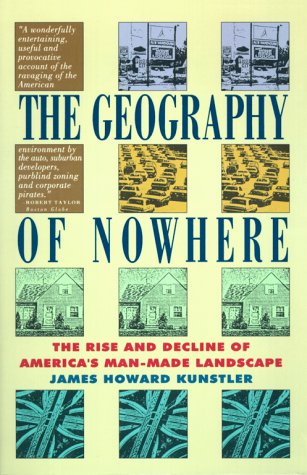
The Geography of Nowhere


Is a book by James Howard Kunstler, written in the mid-90s lamenting the loss of main streets and coherent communities in America. His main thesis is that the American cry of "you can't tell me what to do with my land!" has resulted in what he calls "scary" places--cement-block buildings, kitsch architecture, and "nowheresville" suburbs. Inner cities have been abandoned for "safer" places, thus making any kind of mutual dependency or community next to impossible (in fact, often the appeal of "the next great place to live" is its exclusivity/privacy/distance from the "down and outs."
I grew up in a neighborhood in Memphis, TN which was originally out in the country (it was on a beautiful pond surrounded by trees) but gradually got taken over by suburban sprawl (read Wal-Mart and six lane highway). Kunstler's book put into words what I had felt most of my life but couldn't express, plus I thought his solutions (you'll have to read the book) were quite in line with a biblical worldview (even though he is quite hostile to Christianity). I wrote him an email to say thanks and didn't think I'd hear back. But what do you know, some authors actually care about their readers! Here's my email and his response:


Hi James,

I wanted to drop you a short note to say "thank you" for your book. I read it this summer. You've given justification (and cogency) to my childhood's "backseat rantings" (as I imagine my parents calling them) about the horrors of living in a suburb. I grew up in a suburban neighborhood in Memphis, TN. I heard about your book through an interview with Thom Yorke in Spin.

One question that kept coming up as I read (I'm a Presbyterian campus minister):

Didn't Christianity/the church play a major role in establishing the town model you celebrate in The Geography of Nowhere? One of the things I lament about the modern church is how it has given up its stance in the center of life (especially in America's cities), and that seems to be concurrent with a weak understanding of/interaction with our own history (and a lack of faith in Christianity's relevance in the modern world). Memphis is a perfect example. When I recently went there to visit family, I noticed all the historically "city-center" or at least "community center" churches have all moved to a non-descript, blasted landscape (yes, pastors can read Ferlinghetti) with literally NOTHING around (no poor people, no buildings, no NOTHING!). They are communicating physically what they've concluded theologically/culturally: "We have nothing to say to the complex problems of life/we are no longer recognized as a source for answers to difficult questions/retreat is the ONLY viable option."
Granting you the modern church's failures, then, where would YOU trace the origins of the community model you're buying into? I'm buying it too, as I think it is a thoroughly BIBLICAL model--you may disagree! :) After all, the Bible begins in a garden and ends in a city!

I would LOVE to hear your thoughts (if you have time).

Cheers,
Joey

KUNSTLER'S RESPONSE:

Joey--
Well, thanks for the compliment.
Must have been an annoying childhood.
I've been to Memphis and the devastation of the city center is impressive.
The origin of the community model I buy into is the American civic experience prior to the end of World War Two.

Jim
"It's All Good"

TO MY READERS AND CORRESPONDENTS: I'm getting swamped with e-mails again, and it is necessary for me to ask for your cooperation. I will gladly answer urgent or compelling letters, but please don't overload me with links, clippings, or plain old chitchat. I appreciate your understanding.

Friday, September 01, 2006

Nadine


We spent a weekend in Cape Cod last week (our first time there) with the Hickmans (RUF St. John's). The Black Dog (Martha's Vineyard) was monumental--do yourself a favor and get the Swordfish if you ever go. This is Nadine sporting her Black Dog tshirt. We don't call her the "Dean of Cute" for nothin.

Out of the ashes of Andytown comes...

This blog. While this is no attempt to re-create the genius that was the Andytown blog, I hope to at least make this worth your while. If you've come here from the RUF UConn site, welcome! I'll be posting some messages from Tuesday nights as well as some thoughts on culture, music, theology, ladder golf, Settlers of Catan, and pogo-balls. That last one is for my sister if she ever reads this. (Now THAT was a great Christmas. I bounced the snot out of that thing.) Also, you should anticipate a lot of pictures of my daugther Nadine (and my other daughter when she arrives!) Brace yourselves, this is going to be really, REALLY good. Or just better than average.